Have you ever noticed how the internal state changes, it is worth only to hear the first notes of a flute? The air as if becomes thicker, the space — wider, and the flow of thoughts instantly slows down. We are used to attributing this to “atmosphericity,” but behind this effect stands an amazing symbiosis of acoustic physics, neurobiology, and millennia of evolutionary memory. Let’s figure it out step-by-step, how exactly this instrument manipulates our consciousness.
Acoustic “Transparency”: Physics of sound that has no weight
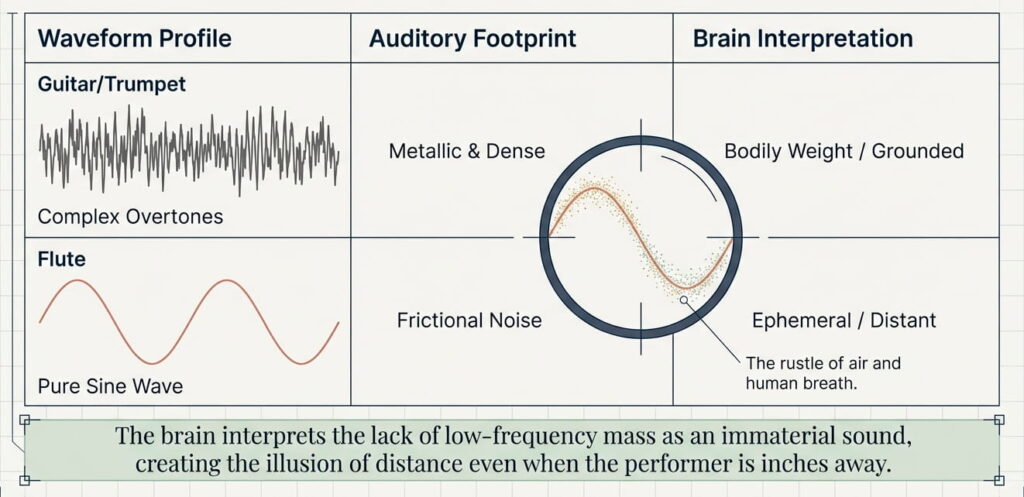
The majority of musical instruments, to which we are used, create a very dense, “material” sound. For example, a guitar string vibrates with a large quantity of metallic overtones, and a trumpet literally pierces the space with its power. The flute, however, works by a completely different principle. Its timbre in physics is described as an almost pure sine wave. This means that in its sound there is a minimum of acoustic “garbage.” But the main feature is the ratio of tone and noise. When a flutist plays, we hear not only a pure note, but also frictional noise — the rustle of the air itself and the breath.
- Effect of “immateriality”: Our brain interprets such sounds as ephemeral. Since in them there is no low-frequency “mass,” they do not have “bodily” weight. An illusion arises that the sound is not tied to a specific point in space. It seems distant, even if the performer stands nearby.
- Feeling of space: Because of the purity of the tone, the flute does not “clutter” the sound landscape. It leaves room for echo (reverberation). That is exactly why a flute in the mountains or large halls creates a feeling of an infinite horizon. A sound that opens the space around.
Neurobiology: How the brain reacts to “voiced life”

Our brain is a biological supercomputer, whose settings were formed for millions of years in the wild nature. And the flute hits directly into these basic “firmwares.”
- Breathing as a signal of intimacy: The flute is, perhaps, the most anthropomorphic instrument, because it is literally a continuation of the human exhalation. Unlike the piano, where the sound is born through a mechanical strike of a hammer, in the flute we hear life. Our limbic system (responsible for emotions) is extremely sensitive to the sounds of air flow — whispers, sighs, soft wind. This activates the centers of attention, causing a feeling of deep closeness and trust. We subconsciously perceive this sound as “safe” and “alive.”
- “Bell effect” and relaxation: High, pure tones of the flute lie in the range which evolutionarily is associated with natural signals: the singing of birds on a fine day or the light rustling of leaves. Psychoacoustics confirms: such frequencies help the brain to turn off the “fight or flight” mode and activate the parasympathetic system, which is responsible for rest and recovery. When a flute sounds, your brain receives the command: “Predators are not nearby, around is calm nature, one can relax and move into the mode of dreaminess.”
Evolutionary memory: Forty thousand years in our genes

Archaeological finds (for example, a flute from the Divje Babe cave, made from a bone of a bear) prove that flute instruments exist for over 43,000 years. This means that they appeared long before writing, cities, and modern civilization. Throughout millennia these instruments had a clear context:
- Pastoral culture: The flute was the only companion of a person in complete solitude among the wild nature. It filled the emptiness of the evening landscape.
- Rituality: Because of its “unearthly” timbre, flutes were used in rites for connection with the spiritual world.
Today we have what scientists call cultural neuroplasticity. Even if you were born in a megacity and never saw sheep, in your subconsciousness there is already written a stable archetype: flute = nature + solitude + something otherworldly. We do not learn this specially, we absorb it with thousands of fairy tales, legends, and stories which formed humanity. It is like the “voice of ancestors,” which the brain recognizes instantly.
Cinema and musical coding: Why does the Shire sound exactly like this?
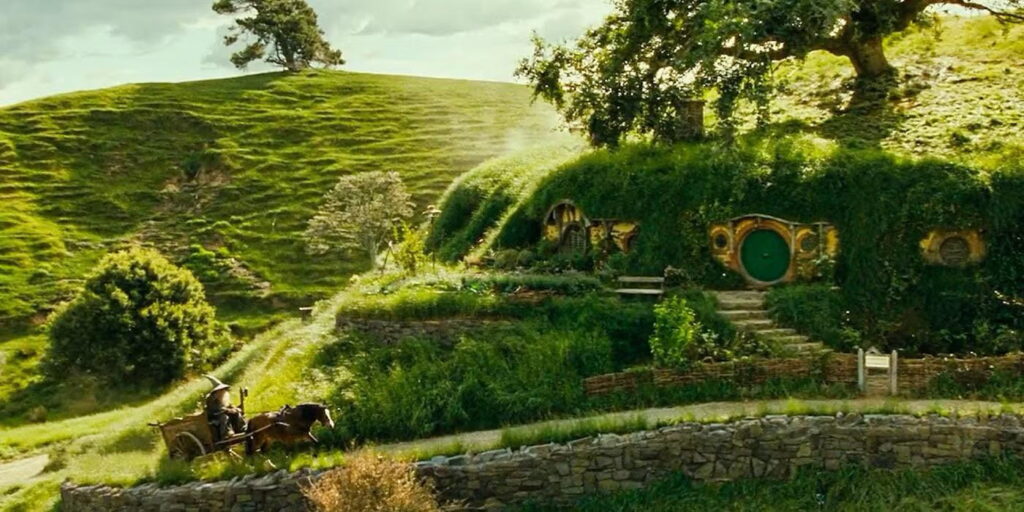
We do not simply listen to music in cinema — we decode it. The composer of “The Lord of the Rings,” Howard Shore, used the flute and the whistle as the main instrument for creating the image of the Shire. And this was not a random choice of a “pleasant melody.”
- Symbol of innocence and home: In a large symphonic orchestra, where powerful brass trumpets and dramatic violins reign, a lone flute sounds defenseless. This is an ideal metaphor for hobbits — small creatures in a huge, dangerous world. When we hear the theme of the Shire, our brain instantly reads: “This is home. This is safety. This is something simple and real.”
- Archetype of “Ancient Magic”: When the plot moves to the elves, the character of the flute changes. Here, long notes, clouded by reverberation, are used. Since the flute is the oldest instrument of humanity, Hollywood for decades has used it to “mark” everything ancient and magical.
- Emotional resonance: Why do we feel nostalgia while listening to these motifs? The flute is capable of “micro-intonations” — barely noticeable bends of sound that resemble a human sigh or crying. This hits directly into the emotional centers, bypassing logical analysis. You do not just watch the movie — you feel the longing for home together with Frodo.
Psychology of the performer: What happens when you take the instrument into your hands?
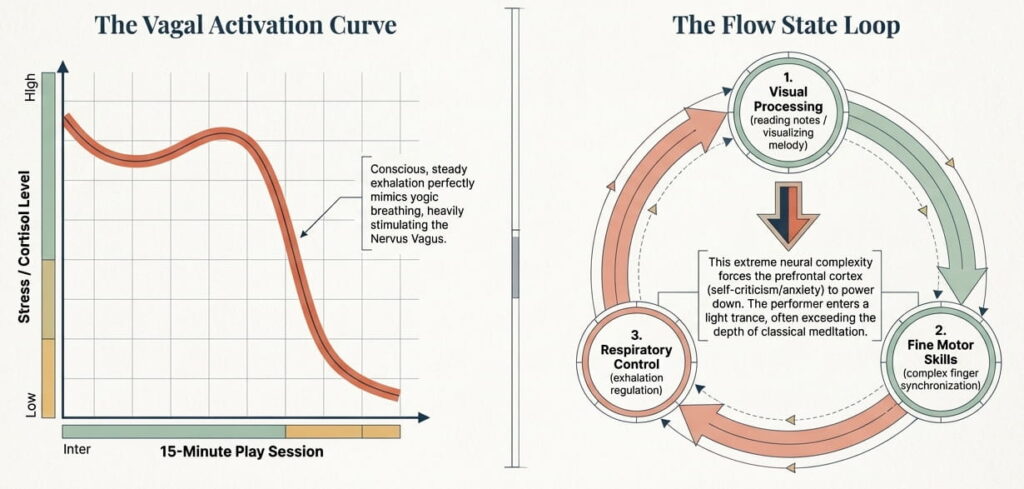
The most interesting effect the flute produces is not on the listener, but on the one who plays it.
- Stimulation of the vagus nerve: Playing the flute requires specific control of exhalation: it must be long, steady, and conscious. From the point of view of physiology, this is identical to deep breathing practices of yoga. Such breathing stimulates the vagus nerve, which is responsible for the “braking” of stress reactions. Exactly because of this, after 15 minutes of playing the flute, a person feels physical calming — the level of cortisol (stress hormone) in the blood objectively decreases.
- State of flow and altered attention: During the play, the brain is forced to synchronize the fine motor skills of the fingers, vision (reading notes or visualization of the melody), and the respiratory apparatus. This neural complexity leads to a state of “flow.” In this state, the feeling of time and one’s own “Self” disappears, and the activity of the prefrontal cortex of the brain, which is responsible for self-criticism and anxious thoughts, decreases. The player falls into a light trance state, which by the depth of relaxation often exceeds classical meditation.
Conclusion: So is this innate magic or a cultural habit?
The answer lies in the middle. We are genetically programmed to react to the sounds of breathing and pure high tones as to something intimate, alive, and safe. This is our biological base. However, culture — through myths, legends, and modern cinema — has carefully layered onto this base images of elves, forest spirits, and pastoral landscapes. This is our cultural superstructure. Exactly this double influence makes the flute such a special instrument. It resonates with our genes and our imagination simultaneously. Therefore, the next time when the sound of the flute makes you hold your breath, know: this is not an illusion. This is your brain recognizing its oldest and most sincere connection with the world.
P.S. From the ancient breath of the flute to the cutting-edge technology of wearable sensors, explore how Mi.Mu Gloves are changing the way we create music in our latest deep dive.
Rate this post along with 0 others