Hi there, friend.
You know that feeling: it’s late at night, a loop is spinning in your headphones, and it sounds like the best thing the world has ever heard. In that moment, you feel like a god. You can already see your track at the top of the charts, imagining the crowd’s reaction to the drop, and you open your laptop the next morning with total confidence.
But a week, a month, or a year passes—and the magic somehow slips away. Instead, you’re met with frustration, constant comparison to others, and that painful question: “Am I just wasting my time?”
I want you to know something: what you’re feeling right now isn’t a sign that you lack talent. It’s pure neurobiology and the psychology of growth. There is a specific “Cycle of Mastery” that everyone has traveled: from Bach to Skrillex. Let’s figure out where you are on this curve, so you can stop beating yourself up and just keep making music.
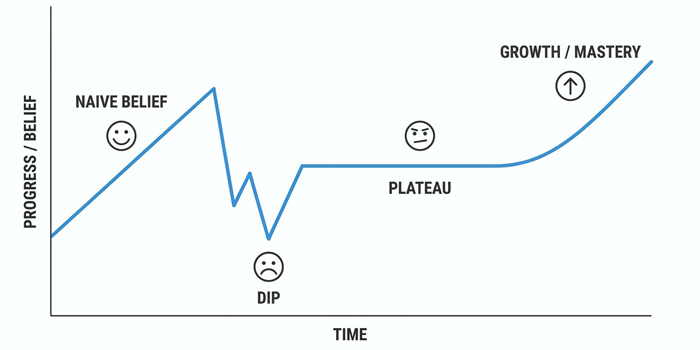
1. The Phase of Naive Belief: “The Producer’s Rose-Colored Glasses”
Every single one of us started here. Psychologists call this the “Peak of Overconfidence.” When you know very little, everything seems simple. You’ve learned how to place a kick and a snare, threw on a couple of effects—and voila, you’re ready to conquer Beatport.
From a scientific standpoint, this is the most crucial stage. Your brain is generously dousing you in dopamine because the novelty of the process creates genuine euphoria. This naive belief is your starting capital. If we knew at the very beginning how many hours would go into learning compression, phase cancellation, or the nuances of marketing, most of us wouldn’t have even opened a DAW.
Advice for this stage: Enjoy this lightness. Don’t try to be a perfectionist yet. Your job right now is to create quantity, make mistakes, and find joy in every sound. This “childlike” drive is exactly what you’ll be trying to reclaim ten years into your professional career.
2. The Phase of Harsh Failures: When Reality Hits Your Self-Esteem
Then comes the “hangover” morning. You send a demo to a label—and get ignored. You drop a release—and three people listen to it (one of whom is your mom). You compare your mix to a track by your favorite artist and hear a canyon: your sound is flat, muddy, and “cheap.”
This is the “Valley of Despair.” Scientifically, this is explained by the gap between your taste and your skills. Your ears are already trained to recognize a high-quality product, but your hands haven’t learned how to build it yet. This is the most dangerous point, where 80% of musicians quit.
This is where the amygdala—the part of the brain responsible for fear—kicks in. Failures are perceived as physical pain. But here’s a fact: failure isn’t the opposite of success, it’s the fuel for it.
Historical Example: Did you know that The Beatles were rejected by almost every major label in London? A manager at Decca Records famously said, “We don’t like their sound, and guitar groups are on their way out.” If Lennon and McCartney had accepted that “failure” as a final verdict, the world would have never heard Yesterday.
What to do? Understand that your pain is a sign of growth. If you don’t like your sound today, it means your musical taste has evolved. Now you just need to catch up on the technical side. Don’t take a rejection as “I’m a bad musician.” Take it as “Version v1.0 needs an update.”

3. The Phase of Slow Progress: The Art of Small Steps
Once the initial shock of the “Valley of Despair” fades, you enter the longest period. Psychologists call this the “Learning Plateau.” This is the time when you’re no longer a beginner, but you’re not a star yet. You know how an EQ works, you understand arrangement structure, but your tracks still don’t quite “pop.”
At this stage, dopamine no longer comes just from the act of making a loop. Now, you need discipline. This is the phase where music turns from a hobby into a craft.
In terms of neuroplasticity, your brain is currently building myelin sheaths around neural connections. Every hour spent on sound design, every failed vocal mix—it’s not wasted time. It’s a physical rewiring of your brain. You become a professional precisely when you feel bored but keep turning the knobs anyway.
Real-life Example: Look at the journeys of Deadmau5 or Avicii. Before the world heard their massive hits, they spent years on forums, deconstructing other people’s presets and writing hundreds of tracks “for the drawer.” Success isn’t one giant leap; it’s a thousand tiny steps that look invisible from the outside.
Advice for this phase: Celebrate small wins. Does the snare sound crisper today than it did yesterday? That’s a win. Did you finally figure out how parallel compression works? That’s a win. Don’t wait for a Grammy to pat yourself on the back. Your goal right now is the process, not the result. If you learn to love the daily routine, you will inevitably reach the next stage.
4. The Phase of Recognition: Sudden Success Years in the Making
And then, one day, a “miracle” happens. Your track lands in a major playlist, a famous creator uses it as background music, or a respected label finally replies: “We love this, send over the contract.”
To outsiders, this looks like “overnight success.” But you and I know the truth: this is the law of accumulated results in action.
Psychologically, this is a very delicate moment. When recognition arrives, the brain receives a massive dose of endorphins. You finally get validation of your worth from the outside world. But there’s a trap: you might start creating for the likes and stats rather than for the music itself.
A vital scientific nuance: There is a term called “extrinsic motivation.” When you start working solely for rewards, your creativity drops. The brain becomes less flexible because it fears risk—it wants to repeat the same successful scenario to get that approval again.
Advice: Accept this success as a nice bonus, but not as the finish line. Recognition is just a tool that gives you more resources to create. Don’t let Spotify numbers become your only yardstick for talent.

5. The Phase of the Existential Hangover: The “…Is This It?” Question
Imagine: you’ve reached the goal. Your track is on the radio, you’ve hit your dream stream count, maybe you’ve even played your first big set. Friends are congratulating you, social media is buzzing. And suddenly, in the middle of this triumph, you feel a strange emptiness. You look at your monitor and think: “Okay, I did it. But why don’t I feel any happier than when I was writing my first messy beat in my bedroom?”
Psychologists call this “hedonic adaptation.” Our brains are incredibly fast at getting used to any achievement. What felt like the top of the world yesterday becomes the new normal today. Moreover, fear sets in: “Can I do it again? Was it just a fluke?”
This is the moment of truth. This is where you realize that success isn’t a destination, it’s just a change of scenery. If your self-esteem relied solely on external numbers, this hangover will be painful. But if you love the actual process of turning silence into sound—you are saved.
Example from the big stage: Look at artists like Jon Hopkins or Bonobo. They’ve stayed relevant for decades not because they chase hype, but because they constantly reinvent themselves. They moved through the phases of success and realized: the real prize is the ability to keep playing the game.
Instead of an Epilogue: Your Music is You
My friend, I want you to remember one thing. Music is not a competition with anyone else. It’s not an Excel spreadsheet that must always move upward. It’s a living, breathing process with its own ebbs and flows.
Failures aren’t system errors. They are part of the architecture of your success. Every deleted project, every “plastic” mix, every label rejection—these are the bricks building your unique style. Without the “Valley of Despair,” you would never appreciate the moments of true inspiration.
Psychology tells us that the state of “Flow” (that very moment when you lose track of time behind your gear) is the highest form of human happiness. And that state is available to you regardless of how many followers you have.
My personal wish for you: The next time you feel like nothing is working—don’t stop. Just turn the volume down a little, close your eyes, and remember why you hit “Record” for the very first time. You did it because there is something sounding inside of you that no one else has. You are a vessel for an idea that wants to be born through your hands.
Don’t be afraid to be imperfect. Don’t be afraid to be slow. True mastery isn’t the absence of falling – it’s the ability to get back up and open your DAW again with that same naive belief you started with.
Create. Fail. Live it. The world is waiting for your next track—not because it has to be perfect, but because it will be yours.
P.S. If you’re curious about how the digital evolution is changing the rules of the game and whether an algorithm can ever truly mimic human inspiration, check out our deep dive into how AI generates music.
Rate this post along with 0 others