When you turn on a relaxed lo-fi beat or classic 90s hip-hop, you aren’t just looking for music; you’re looking for a mood. It’s that same “warm” sound, a pleasant grittiness, and a rhythm that makes your head nod on its own. Behind this magic stands not a soulless algorithm, but the philosophy of one man.
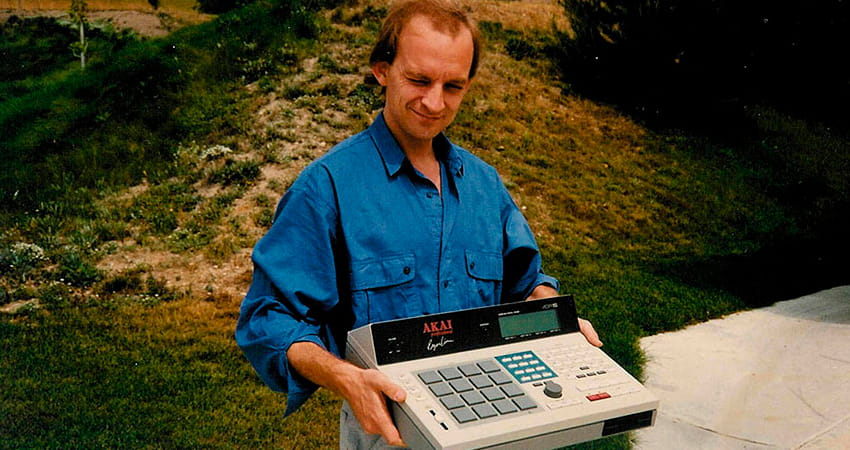
His name is Roger Linn. He is an American engineer whose intuition changed the way we hear the world. The story of his greatest creation — the MPC — is a story about how limitations give birth to true freedom.
An Engineer Who Hated Manuals
Roger Linn was never a typical “tech guy.” He was a musician and a visionary. By the early 80s, he had already created the iconic LM-1 and LinnDrum drum machines, used by the likes of Michael Jackson and Prince. But Roger wanted more — he dreamed of an instrument that someone could start playing immediately, without getting lost in complex diagrams.
Linn admitted that he couldn’t stand reading manuals. That’s why his approach was revolutionary: technology should be intuitive. In 1988, after closing his own company, he teamed up with the Japanese corporation Akai. It was a perfect union: Japanese manufacturing power met an American vision for the ideal interface. Thus, a legend was born — the MPC60.
12-Bit Magic and the Legendary “Swing”
The MPC (MIDI Production Center) was a full-scale workstation that allowed musicians to literally “sculpt” music out of thin air. Roger built several key elements into it that later became the foundation of the lo-fi aesthetic:
- The 4×4 Grid: Instead of small, hard buttons, Linn came up with 16 large rubber pads. They were velocity-sensitive, meaning they responded to how hard you hit them. Musicians started tapping out beats with their fingers, just like on real drums, adding a human touch to the sound.
- “Dirty” Sound: Because memory was incredibly expensive back then, the MPC60 had only 13 seconds of sampling time and a 12-bit architecture. The sound came out “crispy” and raw. Producers call this “natural sounding punch” — when the drums don’t just play, they punch through the mix. What was once a technical limitation became the gold standard of style.
- The Secret Ingredient — Swing: Roger developed a unique algorithm for shifting notes that imitated the natural “sway” of a live drummer. This is what makes your head move to the beat — the “neck snap” that classic beats are so famous for.
The Democratization of Music: From Vinyl to J Dilla
Linn expected people to use his machine for drums. But artists went further: they started “chopping” snippets from old vinyl records and assembling them into collages. The MPC made music democratic. You no longer needed a million-dollar studio or a degree in music theory — you just needed good taste and this box on your desk.
DJ Shadow created his landmark album Endtroducing….. on an MPC60, and J Dilla later took Linn’s ideas to the absolute limit. He famously turned off the auto-alignment (quantization) to achieve his signature “off-kilter” yet incredibly soulful groove.
The Road from Criticism to Reconciliation
Roger’s relationship with his creation wasn’t always smooth. After Akai went bankrupt in 2006 and new owners took over, Linn became one of their harshest critics. He said the company was simply “rearranging deck chairs on the Titanic,” making only cosmetic changes to his 30-year-old design. There were also financial disputes over unpaid royalties.
However, time heals. Recently, Akai sent the master their new model — the MPC Live 2. To many people’s surprise, Roger was impressed. He recorded a video calling the device “the ultimate looper.” He was particularly struck by how quickly one can now create complex rhythmic loops.
There was even a funny moment during his testing: when Linn first heard the sound coming from the new MPC’s built-in speakers, witnesses said his “head nearly popped” with surprise. It was so far from his original concept, yet so convenient, that he admitted the modern Akai had done a “very good job.”
Roger’s Philosophy Today
Even now, while Roger Linn is more focused on his new instruments (like the LinnStrument), he continues to offer advice to Akai. His main message remains unchanged: make it simpler.
He believes that modern MPCs, powered by Linux and high-performance processors, have become true computers, but they are still too complex. Roger dreams of an interface without “excess noise,” where a musician can start creating instantly without reading thick manuals.
The Master’s Legacy
In 2011, Roger Linn received a Grammy for Technical Achievement. But his greatest reward is the thousands of lo-fi playlists that people around the world listen to while studying, working, or simply relaxing.
He proved that technology should serve inspiration, not complicate it. Roger gave us an instrument with its own character. And as long as that “crispy” 12-bit sound and that subtle rhythmic swing exist, the soul of Roger Linn continues to beat in every track.
P.S. The autonomy of the MPC revolutionized not only music but the very lifestyle of producers. Read more on why this instrument created a generation of the “loneliest musicians” in the modern world.
Rate this post along with 0 others