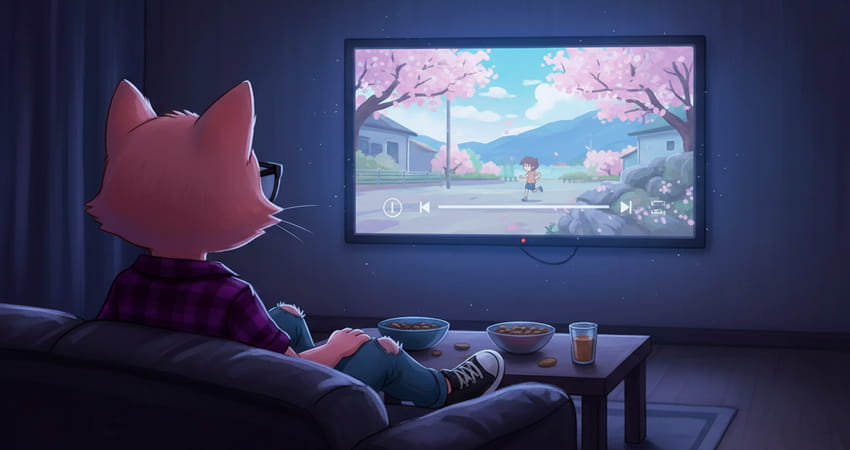
We have grown accustomed to lo-fi hip-hop and anime being inseparable twins. But if we pause the music and think: how did 90s Japanese animation become the official face of a music genre born in the bedrooms of Western producers? Let’s find out.
Artifacts of Memory: From Cassette to Beat
To understand the visual, one must first hear the sound. Lo-fi (low-fidelity) is a manifesto of imperfection. It is music that puts its “scars” on display: the hiss of magnetic tape, the mechanical click of buttons, the dull thud of drums—as if recorded through the wall of a neighbor’s room.
In the 90s and early 2000s, this genre was part of DIY culture. Musicians like J Dilla or MF DOOM created masterpieces not in sterile studios, but in cluttered bedrooms using cheap equipment. These technical flaws suddenly turned out to be incredibly warm. They reminded us of something real, analog, and tactile.
This is exactly where anime enters the frame. Not modern anime with its perfect 4K lines, but the old anime of the “Golden Era”—Sailor Moon, Evangelion, Cowboy Bebop. They possessed that same “graininess” and analog softness. Frames from old VHS tapes had the same texture as the music. It was a perfect marriage of two aesthetics based on the feeling of the “good old days.”
The Godfathers: Nujabes and the Adult Swim Revolution
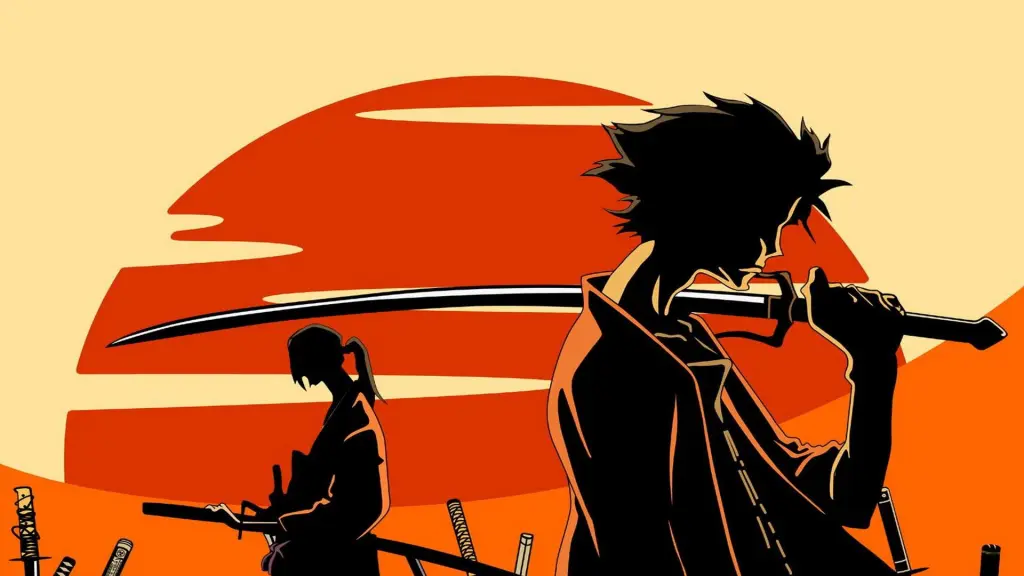
If this union has a birth date, it is 2005. That was the year the world saw Samurai Champloo, directed by Shinichiro Watanabe. It was a cultural explosion: a story about Edo-period samurai told through the language of hip-hop.
The music for the series was composed by Nujabes (Jun Seba)—the man today called the “godfather” of lo-fi. He managed to do the impossible: he merged intellectual jazz with street rhythm, creating a soundtrack that felt not like a background, but like a state of mind. When we saw the samurai Mugen, whose fighting style resembled breakdancing, accompanied by Nujabes’ meditative beats, a connection was forever etched in our minds: anime is not just about action, it is about deep internal reflection.
You can read more about the legacy and life of Nujabes in this article
Meanwhile, in the West, the Adult Swim television block began airing its famous “bumps”—short clips between shows. They used instrumental tracks by J Dilla and other beatmakers over footage of cityscapes or abstract animations. For an entire generation of teenagers who stayed up until 2 a.m., these bumps became a window into a world of calm, adult, and somewhat melancholy art. We learned to relax to anime long before it became mainstream.
The Lofi Girl Phenomenon: A Companion in Your Loneliness
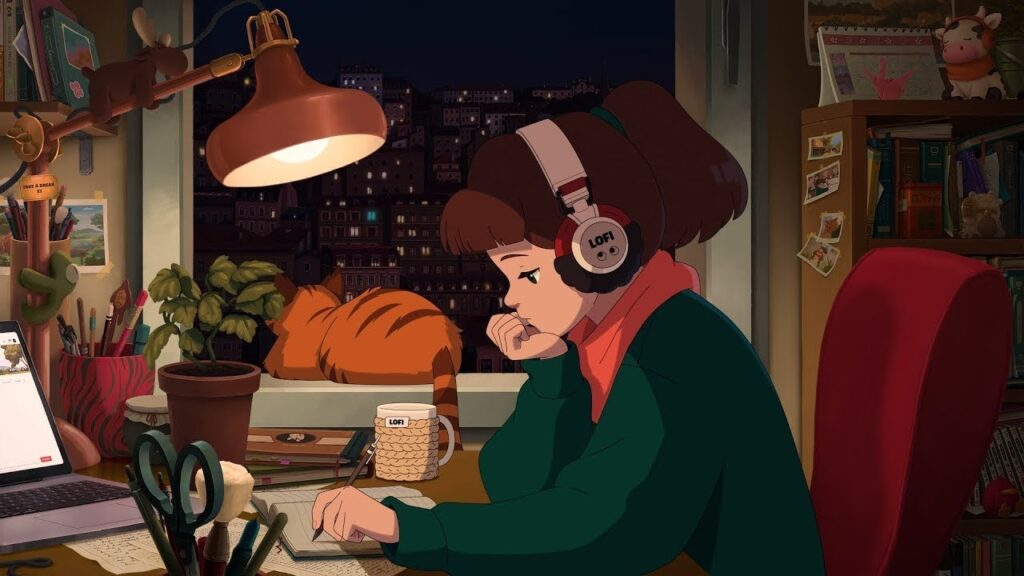
In 2017, a YouTube stream appeared that changed everything. ChilledCow (now Lofi Girl) launched a 24/7 broadcast. Initially, the screen featured Shizuku from the Studio Ghibli film Whisper of the Heart. She sat by the window, writing.
When the frame had to be changed due to copyright issues, Jade appeared—a girl created by artist Juan Pablo Machado. But notice: she remained in the “Miyazaki style.” Why was this so important?
Because Studio Ghibli is the gold standard for the “romanticization of the everyday.” Hayao Miyazaki taught us to see magic in the way a kettle boils, how rain breaks against the glass, or how sunlight falls on an open book. Lo-fi music does the same—it celebrates small moments.
Lofi Girl became a “virtual companion” for millions of people. In a world where we increasingly study or work alone, the presence of this girl on the screen provides the illusion of shared labor. She isn’t distracting because her movements are looped. She simply is. She is a psychological anchor that helps quiet the anxiety before a deadline.
Reflective Nostalgia: Longing for What Never Was
The most interesting part of the anime-lofi aesthetic is the feeling that researcher Svetlana Boym called “reflective nostalgia.” It is a strange state where you yearn for a time in which you never lived.
Most lo-fi listeners are young people—Gen Z and Millennials. They don’t remember 90s Japan; they didn’t use cassette players as their primary device. Yet, when they see a grainy image of a girl in headphones, they feel a pang of longing. Why?
I covered this topic in more detail in an article about lofi as a state and not a genre.
Because it is an idealized past. It is a safe space where social media doesn’t exist, where coziness and analog peace prevail. The anime visual creates a distance between us and reality. It isn’t a photograph of a real girl in a real messy apartment. It is an artistic image, stripped of everything unnecessary. It is a “liminal space”—like a train traveling into the night or an empty classroom after school. Places where time seems to have stopped.
The Psychology of a “Digital Shelter”
Today, we live in the era of “24/7 capitalism.” We are expected to be productive every single minute. Lo-fi with anime visuals became our response to this pressure. It is a kind of “digital shelter.”
The color palette of these videos—pastel pinks, deep purples, soft blues—has a calming effect on the brain. It is the visual equivalent of a blanket. We turn on these streams not to watch them like a movie, but to create a safe “bubble.”
The cyclical nature of the animation (the girl adjusting her headphones, the cat twitching its tail) creates a sense of stability. In a world where news changes every second and each headline is worse than the last, this unchanging image is the only thing one can rely on.
Conclusion
So, why anime? Because it managed to visualize the soul of this music better than any other genre. It combined childhood innocence, adult melancholy, and the aesthetic of imperfection.
Anime-lofi is a modern form of folklore, created by a generation tired of digital noise and seeking peace in the hiss of old tapes. It is a reminder that even on the loneliest evenings, when you are hunched over a textbook or a work project, characters in a parallel digital universe are doing the same. And along with them—hundreds of thousands of other people.
This synthesis of sound and image has created a new language—a visual language of comfort that requires no translation. So, the next time you see a familiar anime loop, listen closely. That is the sound of the echo of our shared need for warmth, silence, and a drop of nostalgia for a world where everything was just a little bit simpler.